Small Business Legal Protection Through AI Technology
The message arrives like a digital punch to the gut. You receive an email with a heading that stops you cold: "IMMEDIATE ACTION REQUIRED: Payment Demand" or "URGENT: Cease and Desist." Your focus instantly changes from business planning and growth strategies to an alarming monetary demand. A request for payment of $50,000, $100,000, or greater sums for an alleged copyright violation or a historical unpaid obligation. Your first impulse is to contact an attorney, but this reaction is soon accompanied by a fresh surge of worry when you hear the retainer fee: $10,000, $15,000, or even $25,000 just to begin. Countless small business operators confront this difficult dilemma-a choice between a settlement that could destroy your business and an economically devastating court fight.
Consider a third possibility? What if you could fight back intelligently, strategically, and affordably? For an increasing amount of entrepreneurs, this solution is becoming available through AI legal defense. This doesn't mean eliminating attorneys completely, but about changing the rules of the game. It's about using powerful technology to assess risks, develop strategies, and know your legal position before spending a single dollar on legal fees. This is the story of how small business owners are turning the tables on legal bullies, saving hundreds of thousands of dollars, and discovering the strength to defend their businesses in an environment of growing legal challenges.
Essential Insights
- The Power Dynamic is Shifting: AI technology now allows company leaders to manage many legal threats independently, reducing reliance on high-priced lawyers for initial defense stages.
- Understanding is Your Greatest Shield: Most legal threats targeting small businesses are designed to intimidate and typically rest on weak legal foundations. Understanding the fundamentals of copyright law and debt validation can be your most powerful weapon.
- AI as a Research Assistant: AI technology can process legal documentation, spot potential claim vulnerabilities, and research relevant case law in a fraction of the time it would take a human, cutting down on expensive billable hours.
- Cost is a Major Factor: With standard attorney retainers starting from $10,000-$25,000, AI-driven legal resources deliver a budget-friendly preliminary protection option at a significantly lower price point.
- Know When to Contact Professional Help: Artificial intelligence is a helpful tool for preparation and initial response, but it cannot serve as a substitute for a licensed attorney concerning complex legal situations or ongoing court cases.
Understanding the Legal Risks and Challenges for Small Businesses
The life of a small business owner involves managing numerous responsibilities. You end up being the executive, marketing specialist, personnel manager, and often the cleaning staff. Legal disputes are the last thing you need in your business journey. Regrettably, today's business landscape is filled with legal risks. Recent data from 2023 indicates that U.S. small businesses face costs of an annual $160 billion in lawsuit-related expenses. We're not talking about just big-ticket litigation; it's the regular legal issues that steadily consume business funds.
The Rise of the Litigation Bully
A significant number of legal threats aren't about seeking justice; they are fundamentally a numbers game. Aggressive collectors, predatory firms, and copyright trolls send out thousands of demand letters, knowing that a portion of targets will be too scared or too uninformed to fight back. They rely on the fact that the cost of hiring a lawyer typically exceed than the settlement they are demanding. This produces a problematic motivation to settle, irrespective of whether the case is valid. These entities serve as legal bullies, using intimidation as their principal tactic.
Critical Threats to Entrepreneurial Success
Even though legal complications may emerge from any direction, several typical problems frequently affect small enterprises:
- Copyright Infringement Claims: These issues are frequently associated with images utilized on company websites or blogs. The majority of these claims are processed by automated systems and sent without proper manual verification of context or fair use considerations.
- Debt Collection Notices: These notices may be for outdated, disputed, or even invalid debts. Collection companies commonly acquire debts for minimal costs and utilize intimidating strategies to recover the entire balance.
- Cease and Desist Letters: These legal documents typically handle a wide range of concerns, including intellectual property conflicts and contractual breaches. They are frequently employed to pressure competitors or discourage critics.
- Banking and Payment Disputes: Disagreements involving financial institutions or payment services can suspend financial access and operations, leaving entrepreneurs to defend their interests.
For entrepreneurs facing these issues, it often seems like a major crisis. What's important to understand is that most of these situations are essentially matters of education and preparedness, rather than legal issues.
The Reality of Legal Defense Expenses: Traditional Systems Failing Small Business Owners
The traditional approach for dealing with a legal challenge is simple: you hire a lawyer. For major businesses with internal legal departments and substantial resources, this is a routine cost of running a company. For a small company, it's a financial earthquake. The typical legal expenses for a small business is around $13,300 annually, but this figure can increase dramatically when court proceedings begin, with fees ranging from $3,000 to over $150,000.
Understanding Retainer Agreements
The biggest immediate barrier is the attorney retainer. A retainer is essentially an upfront payment for attorney representation, and when it comes to litigation, it's rarely below five figures. This leads to what might be described as the "retainer trap." An entrepreneur could get a demand for $8,000. Legal counsel requires a $15,000 retainer to contest the claim. Financially speaking, the practical option becomes settling for the $8,000 demand, even if the demand is without merit. This is the strategy that aggressive plaintiffs depend on. They've strategically set their demands to be just below the threshold cost for legal representation.
Incentive Misalignment
Furthermore, the traditional legal approach is built on billable hours. When a case takes more time, the lawyer earns more money. Although responsible lawyers prioritize efficiency, the framework naturally incentivizes prolonged cases and complicated proceedings. This creates a fundamental disconnect with what matters to small business owners, who require fast, affordable, and effective resolutions. The main goal for the business owner is to address the situation, not to engage in a prolonged and expensive legal battle.
AI's Transformation of Legal Support for Entrepreneurs
Throughout recent history, the high cost of legal services created a significant void in the market. No feasible alternative was available for company leaders who couldn't afford a lawyer but didn't want to surrender to baseless claims. Machine learning is now filling that gap. It's not a magic wand, but it serves as a valuable resource that balances the scales by significantly decreasing the cost and time associated with the crucial first phases of a legal defense.
AI as a Super-Powered Paralegal
Think of AI similar to a paralegal equipped with the capability and photographic memory to read thousands of pages every minute. Let's explore its applications:
- Document Analysis: AI systems can thoroughly review legal documents and complaints and instantly identify essential elements, such as detailed accusations, legal statutes referenced, and requested settlement figures. It can compare the materials to vast legal records to discover patterns and potential weaknesses.
- Legal Research: Instead of an attorney dedicating considerable time (at $300+ per hour) examining legal cases, AI technology can analyze legal resources and deliver applicable case law instantly. It can locate details on consumer protection laws, fair use guidelines, or debt validation requirements that apply to the situation.
- Drafting Assistance: AI is capable of preparing first response letters. When given the claim details and applicable legal standards, it can produce a professional, organized reply that asserts your rights and puts the opposing party on notice that you will not be an easy target.
This is the turning point. The preliminary review and assessment, which typically runs thousands in legal fees, can be completed with a more affordable investment in a technology-driven learning system.
A Step-by-Step Guide to the AI Legal Defense Framework
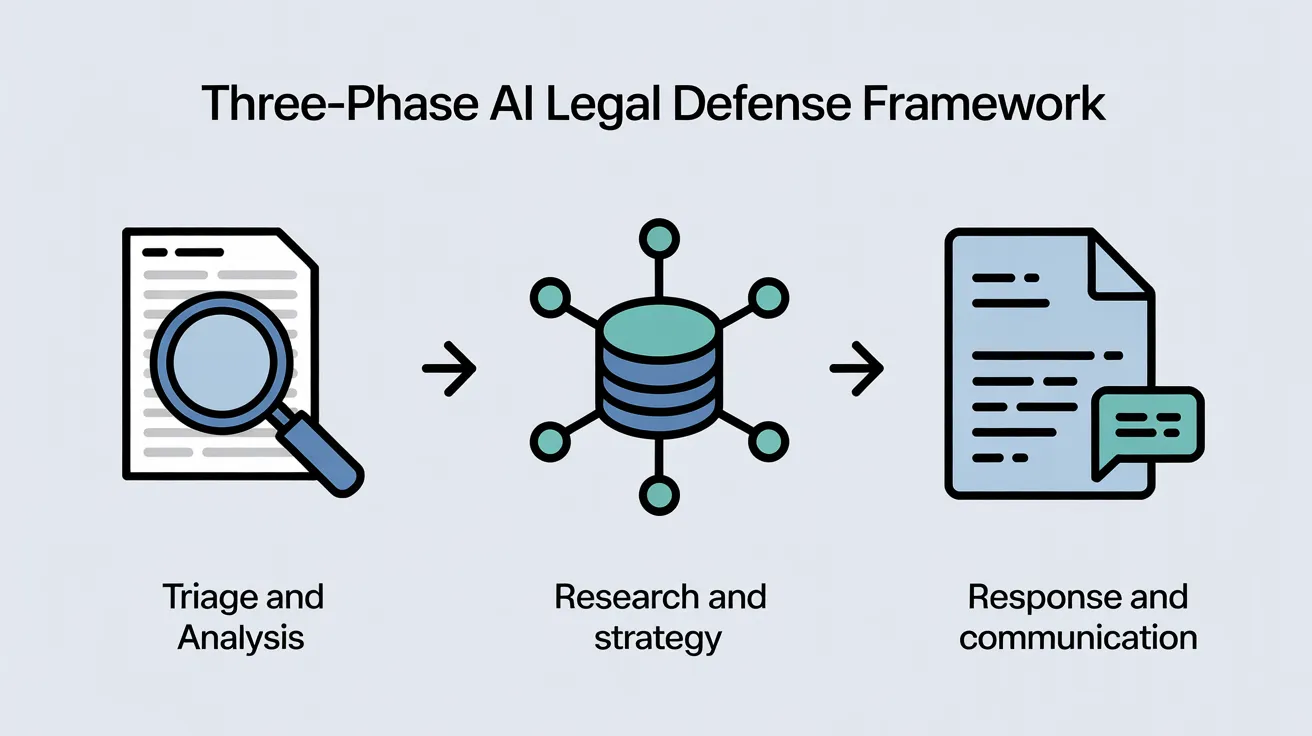
Leveraging AI for legal defense goes beyond blindly relying on a chatbot. The key is following a structured framework to assess the situation, comprehend your position, and respond from a position of strength. This methodology generally involves three essential phases.
Phase 1: Initial Assessment and Analysis
To begin is to leverage artificial intelligence to comprehend what you're dealing with. You can input the legal threat or demand letter into an AI tool and ask it to perform an preliminary review. The goal is to resolve several important points:
- What's the central accusation
- Which specific laws or legal regulations are being discussed?
- Has the party making the claim proven they're the true rights holder?
- What documentation have they shown?
- Do you notice any clear discrepancies within their submission?
This first analysis enables you to progress from feeling overwhelmed to a state of informed awareness. It gives an objective overview of the circumstances.
Phase 2: Research and Strategy
After analyzing the claim, the next process is to use AI to examine your defensive options. For a copyright claim, you should direct the AI to investigate the four factors of fair use and their significance in your unique situation. For a debt collection notice, you must tell it to describe the validation requirements under the Fair Debt Collection Practices Act (FDCPA). This step is about constructing your case. You are collecting the legal principles and facts that will become the basis of your response. This is also where you can initiate to identify the weaknesses in your opponent's position.
Stage 3: Response Protocol
After completing your research, you can utilize AI to help compose a response. This doesn't mean sending a computer-generated response. Instead, it's about employing AI to assist your writing. You supply the essential points and supporting facts, and AI assists in crafting these elements into a well-structured and polished response. Your reply should generally:
- Verify receiving what they sent.
- Articulate your position precisely and succinctly.
- Include the applicable legal concepts that support your viewpoint.
- Seek extra details or validation, as appropriate.
- Stay objective and focus on facts.
This structured response demonstrates to the other side that you are well-prepared, knowledgeable, and organized to defend your position. It immediately changes the dynamic from one of coercion to one of a thorough legal conversation.
Copyright Claim Management: AI Analysis and Response Systems
Intellectual property disputes remain a major concern for internet-based companies. Organizations may incorporate an image on their blog, before encountering a hefty financial demand from an image rights holder down the line. AI can be particularly effective in these situations.
Analyzing the Claim
An automated system can aid in evaluating the legal demand. It reviews the claim letter to check whether it contains evidence of copyright ownership, an official registration number, and a specific account of the supposed copyright breach. Many demand letters from aggressive copyright enforcers are deliberately ambiguous and lack this vital documentation. As one business owner Tony copyright of LinkDaddy discovered, artificial intelligence can be utilized to analyze the legitimacy of a demand, resulting in the successful defense against a $500,000 copyright claim without hiring an attorney.
Researching Fair Use Guidelines
AI can be an effective resource for exploring the legal concept of fair use. Fair use is a legal doctrine that allows controlled utilization of copyrighted material without authorization from the copyright owner. Artificial intelligence can assist you comprehend the four factors of fair use and how they can relate to your case, offering you with the reasoning necessary to build a strong defense.
Validating Debt Collections: AI-Enhanced Defense Strategies
One more field where AI is creating meaningful change is in standing up to aggressive debt collectors. The Fair Debt Collection Practices Act offers business owners and consumers defined legal protections, such as the option to obtain validation of a debt.
The Importance and Strength of a Letter of Validation
A debt collection company needs to provide you with details about the debt, referred to as validation documentation. When you submit a debt validation letter, you are legally demanding that the collector prove that you owe the debt and that they have the legitimate claim to collect it. Many collectors, especially those who purchase old debt, fail to produce this information. An AI can assist you in drafting a thorough debt validation letter that asks for all the essential documentation, such as:
- The original creditor's name
- The account number from before
- A copy of the signed contractual agreement.
- A full accounting of the claimed amount owed.
Submitting a formal validation letter typically halts a debt collector from proceeding. If they cannot validate the debt, they cannot legally continue to try to collect it.
Understanding AI Legal Defense: When It Works and When It Doesn't
It is vital to comprehend the constraints of AI in the legal sector. AI acts as an educational resource and preparation aid, not a legal professional. Identifying the distinction between what you can do independently and when you should seek legal counsel is the key to a solid defense strategy.
Optimal Cases for AI Defense Implementation
- Preliminary Risk Evaluation: Reviewing legal demands and cease and desist documentation.
- Responding to Baseless Claims: Crafting professional replies to aggressive collectors and copyright claims who use intimidation methods.
- Legal Research: Understanding the legal rights and the laws applicable to your case.
- Organizing Your Case: Getting your documentation and arguments ready before consulting an attorney, potentially saving you thousands of dollars in legal fees.
Situations Requiring Immediate Legal Counsel
There are certain situations where you should avoid representing yourself. If you've been served an actual lawsuit, you must hire a lawyer. Additional circumstances calling for immediate legal counsel encompass:
- Criminal accusations.
- Investigations conducted by regulatory government bodies.
- Intricate legal situations involving various parties and legal jurisdictions.
- Critical situations where the possible losses could devastate your company.
In such cases, the role of AI changes from a core defense tool to a support system. You can utilize it to stay better informed and prepared as a client, but you need a human expert in your corner.
Developing Your AI Legal Defense Resource Kit
Starting AI legal defense doesn't need a background in computer science. It mainly needs a willingness to learn and availability of the proper tools. The foundation of your toolkit will be a capable language model like ChatGPT or Claude, alongside an training platform that delivers tailored prompts and frameworks for typical legal threats.
The Critical Role of Quality LLM Inputs
The performance of any AI solution depends on the specificity of your instructions. A basic prompt like "write a response to this demand letter" will produce a general and possibly unsuitable result. In contrast, a specialized prompt will guide the AI to carry out a thorough analysis and generate a reply based on precise legal guidelines. This is why platforms that offer battle-tested prompts and frameworks are so important.
Small Business Success Stories: Standing Strong
The inspiring case of Tony copyright, who protected his business in excess of $511,000 by utilizing AI to defeat three major legal threats, stands as a compelling illustration of what is possible. But he isn't alone. Across the country, small business owners are finding out that they have more power than they believed. They are using AI to contest baseless copyright claims and force debt collectors to verify their debts. These successes are not merely about reducing costs; they symbolize reclaiming a sense of control and choosing not to be victims of a system that has traditionally been stacked against them.
The Future of Legal Defense for Small Business Owners
The adoption of AI in the legal industry remains in its initial phases, but the pattern is clear. The delivery of legal services is growing more attainable and cost-effective. The traditional gatekeepers of the legal profession are facing disruption by digital tools that assist small businesses and individuals. This isn't to say that lawyers will disappear. It suggests that their role will adapt. They will have the opportunity to dedicate themselves to the high-level, complex work that genuinely needs their expertise, while AI manages the more routine and preparatory tasks.
For small business owners, this marks a positive development. This suggests that in the future, a legal challenge may no longer be a cause for financial anxiety, but rather a challenge to be handled efficiently and thoughtfully.
Getting Started: Your Initial Steps with AI Legal Defense
If you are a small business owner, it's crucial to understand AI legal defense is now, ahead of potential challenges. Learn about existing resources and solutions. Understand the basic principles of intellectual property rights and financial claims. By taking these proactive steps, you can protect your business effectively. You can transform yourself from a vulnerable business into a prepared and confident defender of your business achievements.
Most Asked Questions (FAQ)
Is artificial intelligence really effective for legal defense, or is it all hype?
Artificial intelligence serves as a valuable resource for legal defense, but it's vital to understand its role. It doesn't take the place of an attorney. Instead, consider it an incredibly powerful aid for research and document preparation. It assists in review legal documents, comprehend difficult legal concepts, and draft initial responses, all of which results in saving substantial resources. The essential approach is to utilize it for preliminary defense preparation and to recognize when to involve an experienced attorney.
Should I opt for AI tools or professional legal services?
Make use of AI tools to perform the preliminary assessment of potential legal issues, for responding to potentially unfounded claims (such as those submitted by copyright trolls), and to organize your legal case. It's crucial to consult a lawyer right away if you receive with a lawsuit, deal with criminal charges, or are managing a intricate legal issue that could influence your business. A practical approach is: use AI for preparation, but turn to a lawyer for litigation.
What are the realistic savings of AI-powered legal defense?
You can achieve significant cost website savings. Legal fees for initial analysis and demand letter response typically run several thousand dollars. Using an AI-powered platform can reduce this to a fraction of the cost. Early resolution through AI intervention can result in tens of thousands in savings. Should you require an attorney later, prior AI assistance can help decrease their billable hours.
What constraints apply to AI in legal scenarios?
AI systems face several significant constraints. It doesn't have legal status and can't represent anyone in court. It doesn't possess the sophisticated judgment of a seasoned lawyer and may not grasp the complexities of specific cases. Additionally, it functions based on its training data, which could be outdated. Above all, artificial intelligence is limited to providing information and help, not legal counsel.
What's the legality of using AI for analyzing legal documents?
Using artificial intelligence for document analysis and understanding is perfectly legal. You are just utilizing a technological aid for research and preparation, much like using a search engine or word processor. The key legal limitation is that you must not present yourself as an attorney without proper licensing, and the AI cannot act as your legal counsel.
6. How can I tell if a legal threat is legitimate or merely intimidation?
This is where AI analysis becomes very helpful. A legitimate legal threat will typically be specific, include supporting documentation (including a copyright registration number), and come from a reputable law firm. A bullying strategy, in contrast, is often vague, doesn't include evidence, and often features aggressive or unprofessional language designed to force a hasty payment. AI can help you spot these red flags.
The Fair Debt Collection Practices Act (FDCPA): What protections does it offer?
The FDCPA is a federal law that regulates the behavior of third-party debt collectors. You are safeguarded against unfair, deceptive, or abusive practices. One of its most powerful provisions is the ability to verify the debt. If collectors are unable to verify the debt's validity and their authority to pursue collection, they must stop all collection efforts. This is a crucial protection for small business owners who could be pursued for old or invalid debts.